Late frost is a catastrophe when it suddenly appears
Late frost
Cold air incursions with temperatures below 0°C in spring are usually the cause of frost damage to vines. This is due to both climatic conditions and topographical factors, such as the vineyard's location; valley and basin vineyards are far more severely affected than hillside vineyards.
Late frosts occur more frequently when the growing season begins early. This effect can be triggered by warm air incursions in early spring to mid-spring.
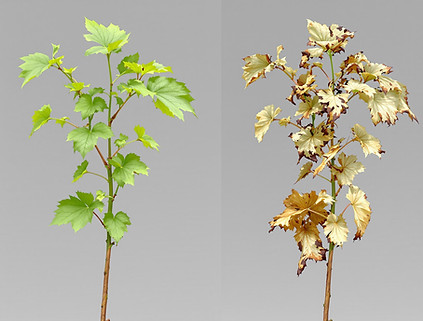
Frost damage to plants can occur in various parts and have a greater or lesser impact on the annual yield. Leaf and bud damage often occurs during low minimum temperatures or during extreme cold snaps in late winter. High temperatures before the cold snap can dramatically increase the risk of damage. Strong contrasts between day and night temperatures can lead to cold stress in the plant. Delayed budding or even the absence of flowering is possible.
A targeted, coordinated, and reliable weather forecast for April is often very difficult to achieve. The large temperature contrasts between cold polar air and warm subtropical air drive weather patterns in Europe.
Climate change
Due to climate change, the mixing of subtropical and polar air is increasing. This means that the probability of cold air spreading from the north is increasing.
The tone of winemakers is clear: In the future, ecologically sound and simultaneously effective techniques must be offered on the market at reasonable costs. The labor input should be so low that additional labor is not needed.
Damage caused by late frost using the example of Champagne
According to a 2021 report, total losses in Champagne were around 20% of those due to late frost
The damage varies greatly depending on the location. In the Aube region, 50% or more of the buds were destroyed in some cases.
Some vineyards reported losses of up to 80% (e.g. Drappier for Chardonnay, Philipponnat on south-facing plots)
Typical annual late frost damage in Champagne currently averages around 20%, but can reach up to 50–80% in extremely affected regions.
In France, the average total damage caused by late frost reaches €2 billion.
State of the art (typical examples)
Many different technologies are already being used to protect against unexpected late frosts. Many regions are plagued by late frosts and have corresponding methods more or less well under control. However, cost pressures and high environmental standards are forcing a rethink in many places, and new approaches are being called for.
Infrared heating wires
The use of (IR) heating wires is very costly, with installation costs of approximately €12,000 per hectare. The system requires a significant power input of 40-100 kW per hectare. Furthermore, the sensitive heating wires can be damaged during cultivation in summer, pruning in winter, and harvesting in autumn.
Wind turbines are already in intensive use in the USA and other parts of the world and are achieving good to excellent results in late frost protection. A 60-75 kW system can cover approximately 4 to 4.5 hectares. It is questionable how effectively wind turbines can be used in steep or often small-scale vineyards and in terraced cultivation. The running costs of a wind turbine are comparatively low (heating wire). However, the acquisition costs are very high at >€20,000/ha. On foggy, damp, or windy nights, this method can be counterproductive. Noise protection can also be a critical issue with larger systems.
Sprinkler systems
Sprinkler systems can generally prevent major damage caused by late frost. This artificial irrigation is a very low-pollutant and simple method. The energy consumed is very low compared to heating or ventilation. Disadvantages are the enormous water consumption and the high installation costs. The water supply leads to leaching of nutrients and soil compaction. Plants can also suffer direct damage. Shoots and branches suffer under the weight of ice. The risk of fungal diseases as a result of irrigation is also not negligible. More than 300,000 liters of water are applied to one hectare in just one frosty night if the system is in operation for eight hours. This method is not suitable for use in water-scarce areas.
Smoking vineyards to protect against late frosts is a historically widespread practice. Dense clouds of smoke delay the radiation of the soil energy stored during the day into the atmosphere. This method can only be beneficial if all winegrowers in a region work together, thus enhancing its effectiveness. The method is very simple to implement; all that is needed are ignition aids, biomass for combustion, and sufficient labor to spread the fuel. The health risks for both residents and employees are significant, and the obvious nuisance, environmental damage, and health risks prohibit this method in most regions.
Paraffin candles containing approximately 6 liters of paraffin wax in a tin bucket are manually ignited by lighting the candles with a Bunsen burner and then burn for approximately 8-10 hours. The installation density is approximately 200 candles/ha in mild frost and approximately 500 candles/ha in more severe frost. The flame releases heat primarily convectively, producing a significant amount of soot containing harmful components of the incompletely burned paraffin. Convective heat input is significantly less effective than radiant heat for combating radiation frost over large areas.